Sorry, www.ridge.co.uk is not supported by Internet Explorer.
Sorry, www.ridge.co.uk is not supported by Internet Explorer.


Our client always intended this project to be a flagship for sustainability. At a very early stage, it ruled out a completely new structure, in favour of retrofitting two derelict Victorian buildings to achieve a BREEAM rating. But carbon targets are evolving rapidly, and so are the expectations of students. When the university adopted an estate-wide policy to reach Net Zero by 2035, it asked the design team, including our Sustainability Consultants, to take another look at the concept design and come up with recommendations to further reduce its whole-life carbon emissions.
“That threw in a little bit of a curveball,” says Susie Sidley, a Sustainability Partner at Ridge, who has worked with the university for over a decade to help it meet its sustainability ambitions. “It was always going to be a challenge to meet BREEAM standards with the existing building fabric, but introducing the carbon target meant we needed to look at the options in even more detail.”
It was always going to be a challenge to meet BREEAM standards with the existing building fabric, but introducing the carbon target meant we needed to look at the options in even more detail.
Measures such as adding insulation or upgrading windows can reduce the amount of energy a building consumes, and therefore its operational carbon. But they also require more materials and energy to produce, increasing the embodied carbon that is emitted upfront as a result of its construction. We carried out a lifecycle assessment to determine the optimal solution, weighing up whether the long-term carbon savings from various potential interventions would justify the initial outlay.
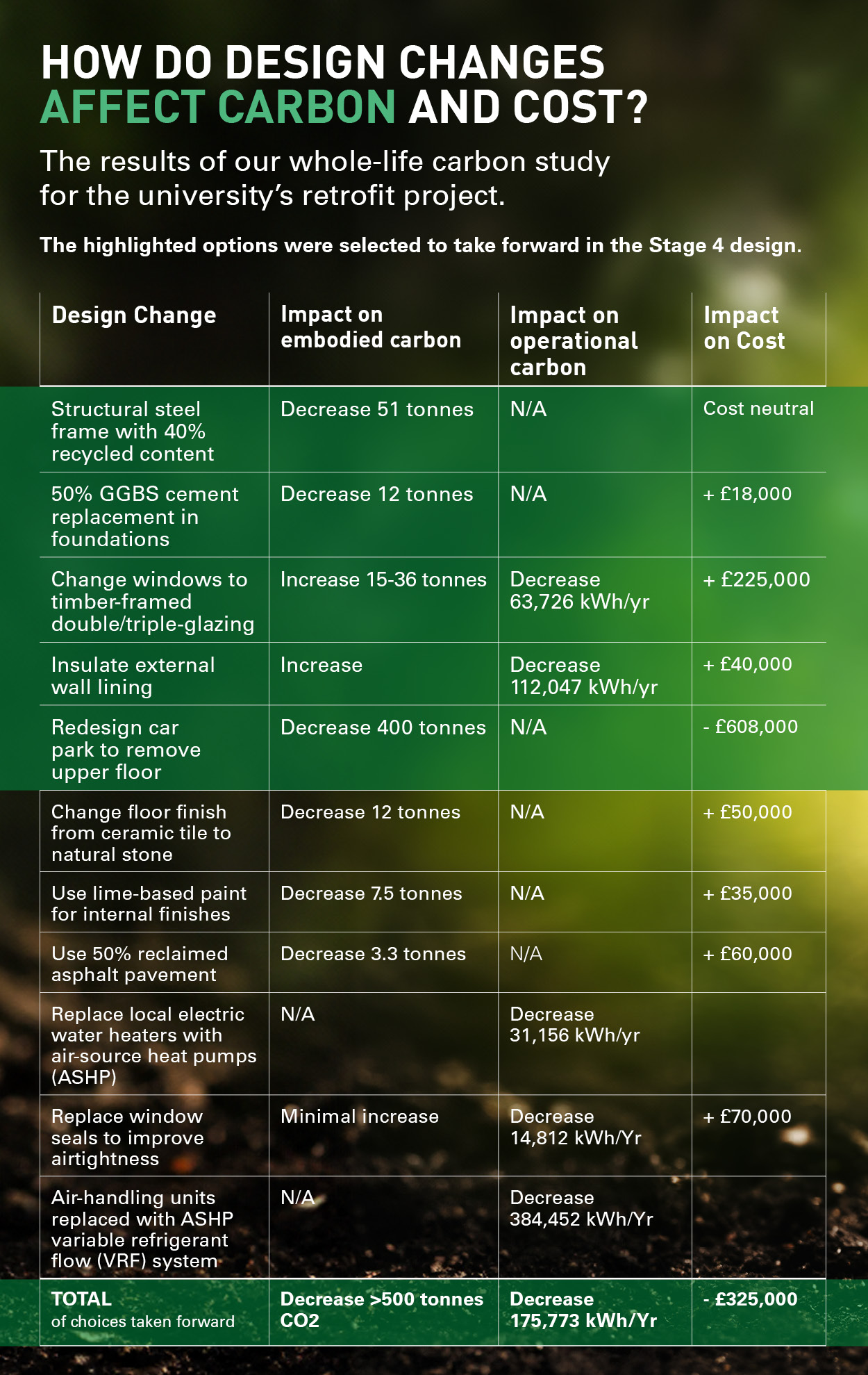
As Sustainability Consultants on the project, Ridge guided the team’s analysis and their eventual recommendations for the detailed design. Working together, they identified a set of changes that could lower the building’s whole-life carbon by more than 450 tonnes, as well as cutting operational carbon by 175 MWh/year and reducing the capital cost by £325,000.
So, how did they go about it, and what lessons might this project hold for other retrofits?
The carbon reduction study focused on the refurbishment and extension of the Victorian buildings, as well as a new multistorey car park and surrounding landscaping. The first step was to establish which of many potential design and specification choices should be included in the calculations.
This meant close collaboration with the architect and MEP engineer, but Susie says that the input of the extended team was invaluable too. “We held a lot of workshops where everyone could just throw in ideas and made a very long list of things that were physically possible,” she explains. “We brought the contractor in, because it was important that our recommendations were practical, and the QS to understand the costs.”
Susie and her colleagues coordinated the process of whittling the long list down to a shorter one, selecting options that were feasible to implement and likely to make the biggest difference. Then, the operational carbon each could save was modelled compared to the baseline design, while the Ridge team analysed the implications for embodied carbon and combined everything into a lifecycle assessment, to understand the trade-offs between them.
For Susie, the biggest surprise was how far the embodied carbon still outweighed operational carbon, before the carbon reduction measures, even though the project was reusing two existing structures. “You would assume with a refurbishment that the operational carbon savings would be more significant – but, in fact, the embodied carbon savings added up to much more, even over a 60-year period. So this shows that you can’t just focus on reducing operational carbon to reach Net Zero and forget about embodied. You really do have to look at both to achieve the lowest possible environmental impact.” It also highlights how much further the balance would shift with a completely new build, she adds.
You would assume with a refurbishment that the operational carbon savings would be more significant – but, in fact, the embodied carbon savings added up to much more, even over a 60-year period. So this shows that you can’t just focus on reducing operational carbon to reach Net Zero and forget about embodied.
The carbon reduction study took place against a backdrop of soaring energy prices, so the university was particularly keen to understand how lower carbon could translate into potential savings. By implementing the operational carbon savings, the university’s energy bills would be £45,000 lower a year, giving an 11-year payback at current prices.
Another key finding was that measures to reduce embodied carbon could also translate into budgetary savings. “There’s an assumption that lower-carbon design always costs more money,” says Susie. “But actually, we found that while there were cost implications for a lot of the options, others were cost-neutral.”
There’s an assumption that lower-carbon design always costs more money. But actually, we found that while there were cost implications for a lot of the options, others were cost-neutral.
Specifying 40% recycled content in the steel frame for the extension cost the same as using 100% virgin material, for example. Meanwhile, redesigning the car park so that the upper deck was no longer needed not only saved 400 tonnes of embodied carbon – the biggest single reduction by far – but also resulted in a substantial cost saving. “So the first thing to consider is how you can do things more efficiently and reduce the amount of materials you need, before adding design measures that do cost more.”
As the project progresses, Ridge will remain involved to support the BREEAM accreditation process, and the whole team is excited to see it take shape, and to draw further insights into carbon reduction. “We always return to a completed project to re-assess, so we can see how the building performs and confirm the actual carbon savings. That’s a really useful point to develop the lessons learned, so we can apply them on other projects.”
You can contact Susie at [email protected]

Thank you for signing up. We look forward to sharing updates with you