Sorry, www.ridge.co.uk is not supported by Internet Explorer.
Sorry, www.ridge.co.uk is not supported by Internet Explorer.

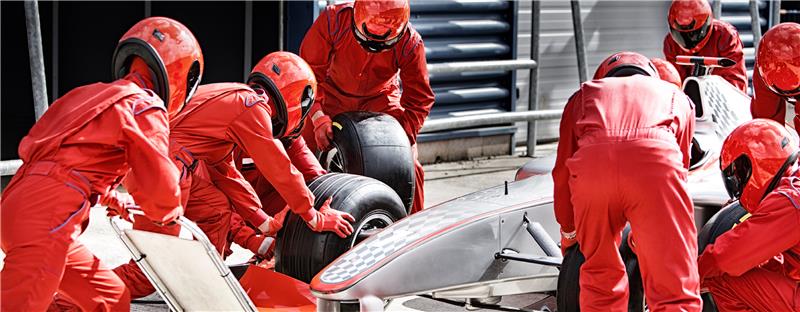
Excitement is building for the start of the Formula 1 season – and the biggest rule change for more than a decade. This year, the teams have had to rethink their cars completely from scratch: new engine, redesigned chassis to meet a brand-new set of regulations, thinner tyres and new sustainable fuels.
What I always find staggering is how few laps F1 cars have done before the first race, given the restrictions on track testing. This year, the teams will have had just three opportunities to see how they perform in real-world conditions. By comparison, a road car might be in development for several years and undergo millions of kilometres of simulated and on-road testing. At the pre-season shakedown in Barcelona this January, when the new cars had their first run, teams completed between 300km and 2,300km.
The sheer level of change in 2026 puts even greater emphasis on testing and simulation back at the teams’ HQs. Testing is essential for safety, reliability and performance, and it’s what enables the cars’ talented engineers to refine their innovations, both ahead of and throughout the season. Over the last 30 years, F1 teams have expanded hugely, many becoming enormous operations with big campuses. Much of that expansion has been driven by investment in test facilities such as wind tunnels, test cells and simulators.
As someone who’s been designing F1 campuses for 30 years, I’ll be gripped by what happens on the track this year – as it will provide vital clues as to what might happen off it, and how the UK’s world-leading temples of automotive engineering will continue to evolve.
What’s the new frontier between testing and track?
When Ridge began delivering F1 factories in the late 1980s, a team might have as few as 50 people, with a small core team of engineers responsible for designing the car. Today, the teams vary from 350 to 1,500 in size. They have highly advanced testing facilities to analyse aerodynamics, structural integrity, systems and materials, simulation tools to piece it all together, and increasingly powerful data centres. Once in-season development begins, they will correlate track data with their test facilities back at base, and combine the two to find performance gains.
But at the pre-season stage, everything is predictive – and there are always unknowns. In the last rule change in 2022, the cars started to bounce violently at high speeds. This “porpoising” motion was created by the reintroduction of ground effect aerodynamics, which relied on low-pressure tunnels under the car to generate downforce. Almost all the teams experienced it, and many had not predicted it, or at least the extent of it, in the wind tunnel or in simulations.
In 2026, there are sure to be other surprises when the cars run on track for the first time, as well as stand-out innovations that set some teams apart. Finally, they will get to see how these perform, and crucially, how they compare to everyone else. The results will determine not only the season standings, but how testing facilities will evolve for years to come.
Will wind tunnels ever go out of fashion?
It’s probably 20 years since people began speculating that computational fluid dynamics (CFD) would replace physical testing altogether. But still the wind tunnel persists, in engineers’ hearts and as a mandatory part of the FIA regulations.
Even with a build cost of around £80 million, and a limited amount of running time, wind tunnels remain highly valued by aero designers. Aston Martin, McLaren and Red Bull have all invested in new ones or significant upgrades recently. Teams without their own tunnel use external facilities or – F1 fans are often startled to discover – share with their competitors, although this is governed by strict FIA rules.
It’s unlikely that any team will be brave enough to completely abandon wind tunnel testing in the near future. The first and only F1 cars designed purely with CFD raced in the 2010 and 2011 seasons for Virgin, but after poor performance the approach was abandoned. Since then, all teams have relied on a hybrid of physical testing, CFD and simulations, and that seems here to stay.
The rise of the automotive tech campus: where will the war for talent go next?
Cadillac’s entry onto the grid, and its unbelievable growth in size over the last year, has created job opportunities across the sector, stimulating movement between teams. There is a war for talent here in Motorsport Valley – nine of the 11 F1 teams have a base within 50 miles of the Ridge Oxford office – and there has never been a better time for aspiring motorsport engineers to graduate.
A big change is that F1 teams now see their workplaces as a weapon in that war. Their buildings used to be very modest, and almost spartan. As designers, we knew that investment was always focused on tools that provided tangible track performance and very good value for money, and our solutions needed to respond to that.
Over the last decade, however, many teams have looked at tech companies and realised that being able to attract the best talent is also crucial to track performance. They talk about campuses, rather than factories, and they’re recognising the value in providing the best possible working environments, alongside the best technical facilities.
There remains a certain romance about the classic race teams: smaller teams have outperformed larger rivals, and this is often attributed to working so closely together. As numbers grow and operations expand, you might think it would be hard to hold onto this spirit. But even if Formula 1 is a cast of thousands, with ever more sophisticated test facilities and tools, what it still comes down to every time is 22 cars racing on track on a Sunday afternoon.
This weekend, the biggest question will be the same as at the beginning of any season with new regulations: which team has found an edge in their interpretation of the rules? That’s something that no one can predict for sure before lights out – and I’ll be on the edge of my seat.
Paul Hartle is a partner at Ridge, a chartered architect and technical project leader on world-class motorsport facilities. [email protected]
Since delivering our first Formula 1 headquarters for Jordan in 1991, Ridge has led the design and construction of motorsport and automotive projects across six continents, supporting winning teams at 15 Formula 1 World Championships. In October 2025, we joined forces with Driven International, a leader in designing racetracks and masterplanning motorsport destinations. You can read more here.

Thank you for signing up. We look forward to sharing updates with you