Sorry, www.ridge.co.uk is not supported by Internet Explorer.
Sorry, www.ridge.co.uk is not supported by Internet Explorer.


What does it mean to “go” to university when you can complete a degree without leaving your room?
This is a pressing question for the higher education sector post-Covid, as a blend of online and traditional teaching has become the new normal. Campuses that have evolved over decades must suddenly meet a whole new set of expectations, while preparing students to enter a world of work that is undergoing a parallel transformation.
People-centric master plan
The University of Portsmouth is responding to the challenge head-on, with a new master plan that refocuses its city-centre estate around the student experience. It is investing £250 million over a ten-year period, as part of a strategy to become the UK’s top modern university by 2030.
“Buildings are more than just a facilitator for teaching, it’s about how they make you feel,” explains Tahir Ahmed, Director of Estates and Campus Services. “Yes, online learning is here to stay, but ultimately we feel that students benefit from being together in the university environment, interacting with each other and with their teachers.”
Prior to joining the university in 2022, Tahir spent 30 years in healthcare. “When you arrive at a hospital, you should feel instinctively that you’re going to get well,” he says. “We’re applying similar principles. Our vision is to create an environment where you feel that you belong, and that you’ll achieve great things from being here.”
Like many UK universities, Portsmouth has grown rapidly with rising student numbers, to occupy an eclectic range of buildings across the city. The master plan will rationalise this disparate estate, making it more efficient, sustainable and digitally enabled, and uncovering opportunities for redevelopment. But above all, it aims to make it more people-centric, responding to the much greater priority today’s students place on wellbeing and inclusivity, and giving them plenty of reasons to emerge from behind their screens into university life.
Our vision is to create an environment where you feel you belong, and that you’ll achieve great things from being here.
Tahir Ahmed, Director of Estates and Campus Services
A student hub at the heart of the plan
The Portsmouth campus is reenvisaged with a central spine, connecting all of its teaching facilities and bringing them within easy walking distance. This flows into a “heart” space that will combine significantly expanded community, pastoral and support functions.
The impetus for the project was the opening of the award-winning, BREEAM ‘Outstanding’ Ravelin Sports Centre in 2023, says Tahir’s colleague, Deputy Director of Capital and Property Estates Chris Luff. “That’s been incredibly successful, and prompted us to rethink the whole plan. Looking at how much the students were using the sports centre, going from there to the library next door, and back again, was a lightbulb moment.”
The master plan consolidates and reinforces that activity with a new Student Hub, adjacent to the sports centre. Today, the site is partially occupied by the student union, upstaged and underutilised since the Ravelin opened its doors. The new Student Hub will build off this structure, bridging the existing gap between the student union and the library, and adding pastoral and community space designed to the WELL building standard.
This is a constantly changing environment, so anything we build today has to be flexible.
Chris Luff, Deputy Director of Capital and Property Estates
Flexible, efficient, sustainable, intelligent
The other strategic addition will be a new Technology building, consolidating five buildings of varying ages and character. “Utilisation is key,” says Chris. “It’s about making our assets work harder for us.
Reducing space duplication and waste, assisted by modern technologies, allows buildings to become more flexible and to be shared holistically across the campus. We will have additional, better-quality space, that is more available to the students. That feeds into the overall student experience, which is fundamental to everything we do.”
Crucially, the spaces will be much less rigidly programmed than the university buildings of the past, able to accommodate different subjects and learning styles, and to adapt over time. Portsmouth already offers some cutting-edge specialisms – such as creative technologies, automotive engineering, and mission design for space exploration – and these will continue to evolve. “To be a top university, we need to build on our principles to offer the right courses and set people up for future employment,” says Tahir.
And while the days of one-way “chalk and talk” lectures are over, it’s much less clear what might come next, adds Chris. “This is a constantly changing environment, so anything we build today has to be flexible. That’s very important from a sustainability and carbon point of view, so we haven’t got to knock it down in 20 or 30 years. We need to be agile enough to respond to whatever’s coming.”
In practice, this means standardised building services, and floorplates with fewer fixed structural elements. “It’s about infrastructure that allows you to expand or contract in different areas,” says Chris. “Flexibility doesn’t mean building more space, it means monitoring how it’s used.”
Connected campus
It also means creating what Tahir prefers to call “intelligent” buildings, with a mesh of sensors feeding a centralised control system. “You won’t see it, but it’s a really big part of what we’re doing behind the scenes to manage space more efficiently,” he says. This will allow the estates team to monitor environmental quality and utilisation in real time, and it will support predictive maintenance and security.
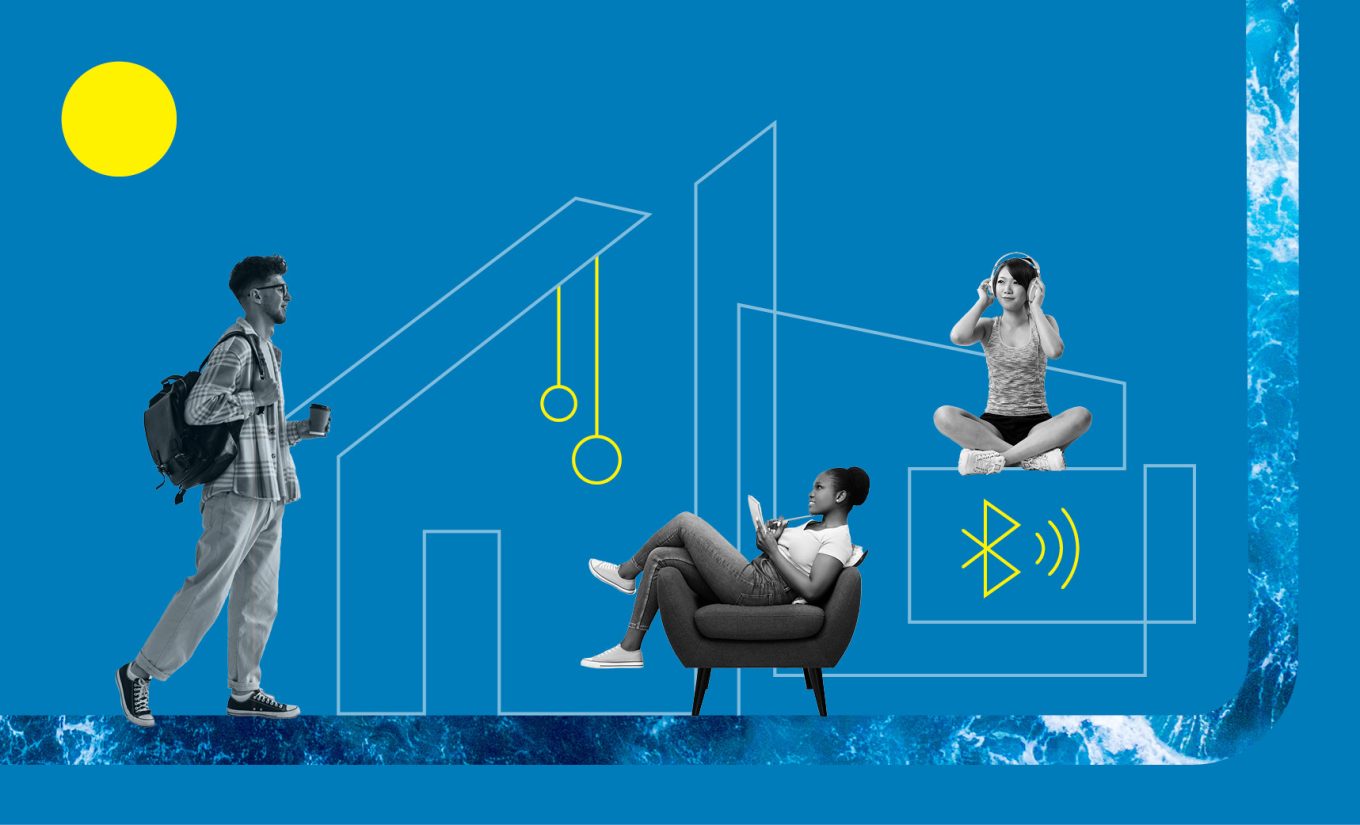
Students will be able to use their phones or tablets to see how busy different spaces are, and digitally interact while learning, in order to choose the environment that suits them best. These principles will be embedded into the design of new buildings, and a parallel retrofitting programme will see the technology installed into legacy buildings as part of the refurbishment cycle.
Tahir thinks the university of the future will be more outwardly connected too. The master plan is intended to reinforce the university’s civic role, and to create new opportunities for links with local industries and the community. “Physically, you’ll see a remodelled campus, and that in itself creates opportunity and encourages others to invest in the city, supporting further innovation and progression.”
Creating a unified campus may be more complex in an urban location, but he believes it’s exactly that relationship that will set the Portsmouth student experience apart: being in the centre of a vibrant city, immersed in greenery, with views of the sea and the beach.
“If you could take those surroundings and build a sustainable, connected campus with opportunities for social learning, why wouldn’t you? We’re on a win-win.”
“Buildings are more than just a facilitator for teaching, it’s about how they make you feel.”
Tahir Ahmed, Director of Estates and Campus Services
Read more about the University of Portsmouth’s master plan
Read THE UNIVERSITY CHALLENGE: Reshaping estates to unlock hidden value

Thank you for signing up. We look forward to sharing updates with you