Sorry, www.ridge.co.uk is not supported by Internet Explorer.
Sorry, www.ridge.co.uk is not supported by Internet Explorer.

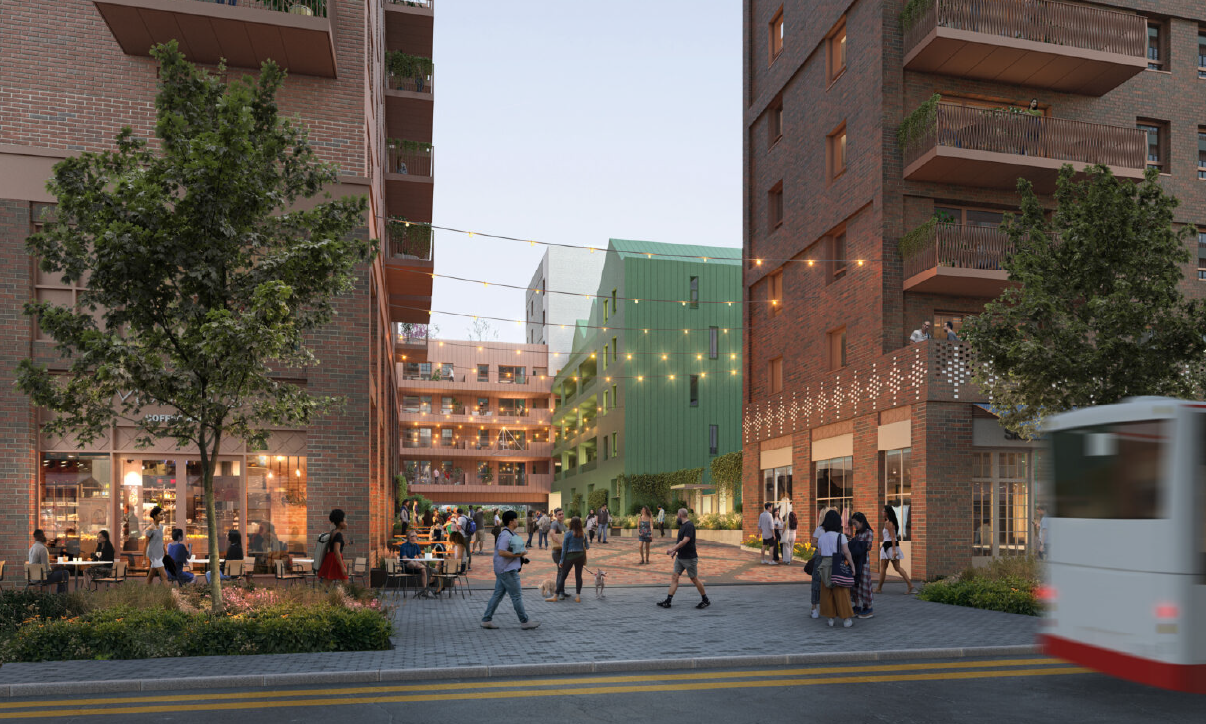
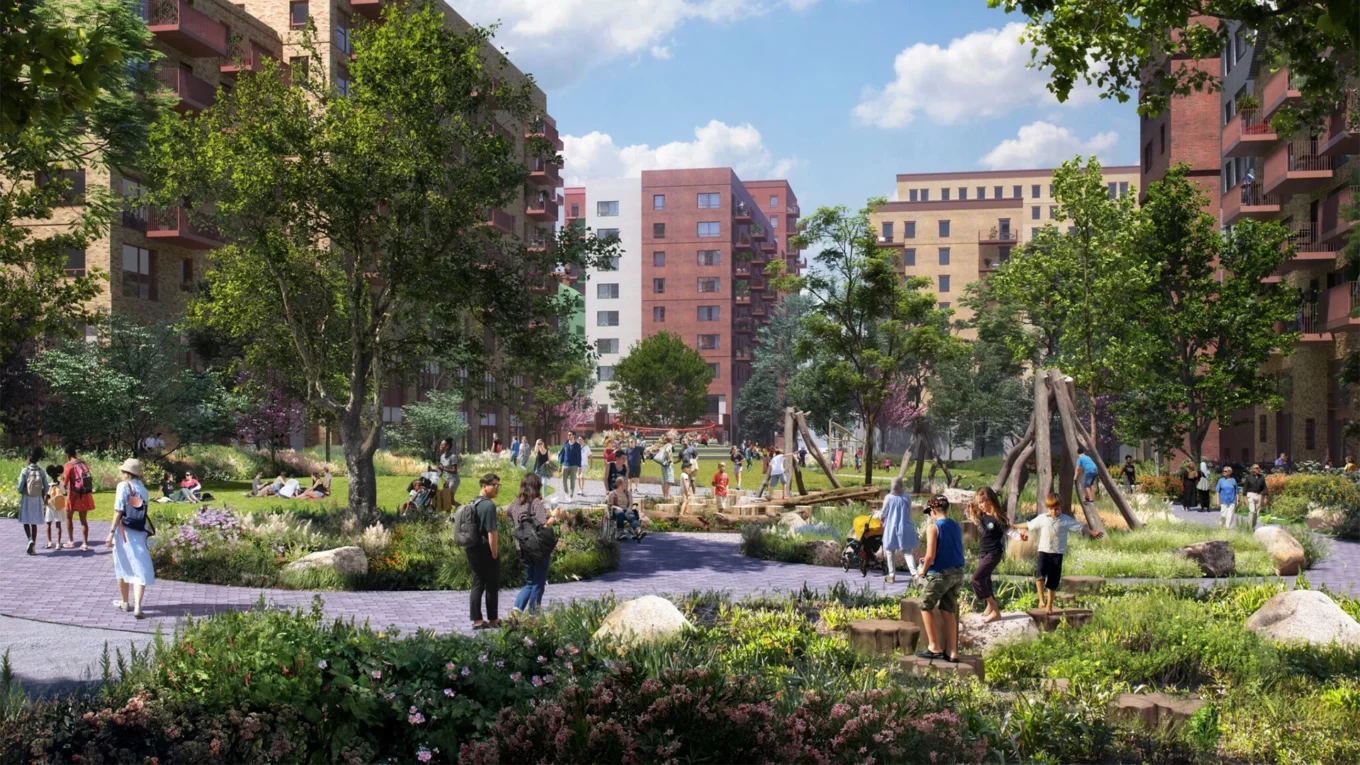
Today, Smithfield is a vacant 17 hectare plot at the heart of Birmingham, but over the next ten years, it will be transformed into a vibrant mixed-use district providing more than 3,000 homes and 9,000 new jobs.
Ridge is part of the Smithfield team, providing project management services for the £1.9 billion development, which is just breaking ground. This is undeniably a mammoth scheme, but its success will hinge not only on how effectively it’s delivered, but on a masterplan that has already been a decade in the making.
So, what does it take to create an authentic piece of city from a completely blank canvas? We spoke to the team to find out.
Smithfield is where the city began: in the mid-1100s, Peter de Birmingham was granted the right to hold a weekly cattle and food market in the grounds of his manor house. But its more recent history begins in 2011, when Birmingham City Council released its Big City Plan for a 20-year transformation of the city. This envisaged the removal of the ring road and much of the traffic, allowing the central core to expand by 25%, improving connectivity, diversifying the economy and foregrounding its unique heritage.
Smithfield, then known as the Southern Gateway, was an essential piece of the puzzle. The development of the wholesale markets in the 1970s had disrupted Birmingham’s original street pattern, imposing what the council described as “a fortress-like building that turns it back on the surrounding area”. It bought a new site on the outskirts of the city, and in 2018, the wholesale markets were relocated to a brand-new, purpose-built facility – freeing up this enormous, strategic site to anchor the next phase of Birmingham’s reinvention.
It’s not often you get to work on a site of this scale, in a city centre in the UK – and not just any city centre, but Britain’s second biggest city. It’s a virtually unheard-of opportunity.
Selina Mason, director of masterplanning and strategic design at developer Lendlease.
Smithfield has very strong connections to both the city’s authentic soul, and to its present-day infrastructure. The site is hyper-connected, close to two major railway stations, a soon-to-arrive high-speed line into London and the iconic Bullring shopping centre.
It’s also bounded by China Town, Gay Village and Digbeth districts, says Sammas Ng, associate director at masterplanner Prior + Partners, who has led the masterplan and phase one team since 2019. “They’re vibrant places in their own right, but Smithfield really feels like it’s the end of the city centre, and like it’s waiting for something to happen.”
The masterplan taps into this, with a blend of uses that complement its surroundings: “At Smithfield, we have this very unique, super-central location and a lot of ingredients for making a solid part of the city: the market, the cultural building, the new squares. It’s embedded into the context of Birmingham and the mix of uses that already exist.”
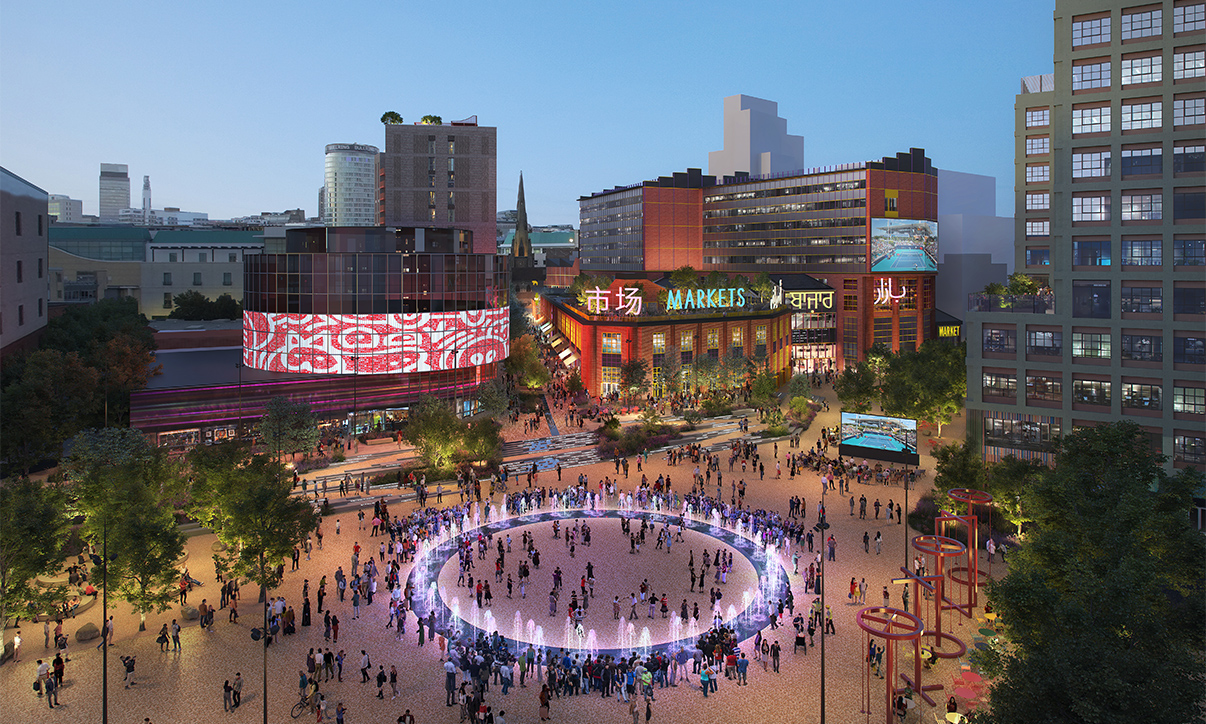
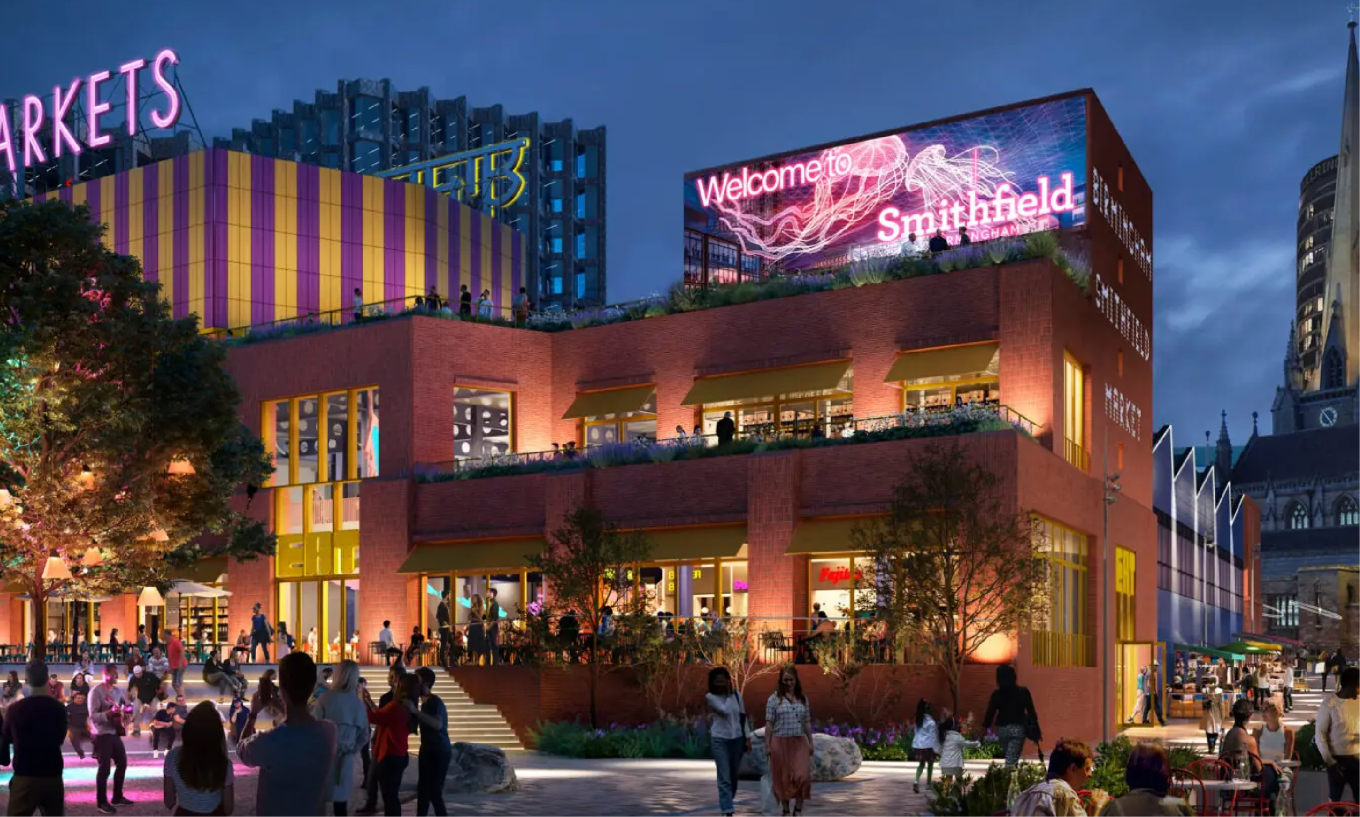
A reimagined retail market building will be the focal point of the Smithfield development. “That’s a huge opportunity to create somewhere the whole region can come together,” says Selina. “Food is such a convening thing, and gathering round the table, whether that’s at a family scale or a city scale, is always going to attract people.”
But Smithfield will also be a brand new residential area, something that’s lacking in the city centre today. Birmingham’s post-war modernist planning favoured demarcated single-function quarters, dedicated to retail or offices or entertainment with very little mixing – out of step with the urban renaissance that’s taken place over the last couple of decades, she points out. “From 2000 onwards, cities like Manchester and Liverpool have been completely transformed by people living in them. Birmingham is probably about 20 years behind. People are starting to move in but there’s an almost completely untapped market.”
When Lendlease won the developer competition in 2017, Birmingham City Council had already consulted extensively on its own masterplan, and this became the basis for the first planning application, submitted in December 2022. This envisaged a new market square, homes, offices and an outdoor event space, anchored by a large new building for the Bull Ring markets, where the wholesale market building had stood. But that had also been the location of the de Birmingham moat and manor house – which led Historic England to object.
The team went back to the drawing board. During a year of intense collaboration, they reconfigured the plan and completely redesigned key buildings. A large public space became the centrepiece of scheme, and the market building shrunk and split into two. Preserving its viability required a tricky rebalancing act in order to provide a similar level of residential and commercial space.
“One of the most enjoyable parts of this project is that there were always really good debates, and everyone made a worthwhile contribution,” says Matthew Winn, Project Management partner at Ridge. “Nobody was ever frightened to make a suggestion and nothing was off the table. That helped to generate different ideas and ways of doing things, and a lot of innovation.”
One of the biggest questions for the team was how to reflect the historic importance of the site, in the probable absence of any physical remains. “We think this is where the northern side of the moat might be, but it was probably never constructed other than as an earth ditch, and over time that edge would have moved a lot,” says Selina. Centuries of construction have churned up the site, so that the ground beneath the concrete slab is a soup of medieval and modern relics, and much in between. “It’s a classic bit of Victorian city, so what archaeologists have tended to find is that it’s highly fragmented and disturbed.”
Their eventual solution was to echo the line of the moat in the new public square: “We spent a lot of time debating what it is about history that is meaningful,” explains David Kohn, founding director of David Kohn Architects, which won the international design competition to design the market building. “There are all these moments where you’re in the basement of a shopping centre, and there’s a scratchy glass surface, and you look through it and there’s some condensation and a bit of mouldy stone. There’s not much fun or pleasure in discovering that, whereas I think this will be a really great public space. That takes the pressure off whatever is in the ground, but it also has great value for a city that has often struggled to connect to anything other than the recent past.”
Historic England agreed, and the revised outline planning application was unanimously approved by the council in June 2024. A landmark mixed-use building with 408 built-to-rent homes was also approved in March 2025, and construction of essential infrastructure has begun on site.
It’s an big step forward for Lendlease and its team, which has already been working on the plans for the best part of a decade. But Matthew hopes it will also be an enormous leap forward in Birmingham’s long-running economic success story.
The most important thing is the outputs that a scheme like Smithfield brings: the economic benefit and to the quality of life for people in and around the area, and the potential for new jobs, education and skills. It’s also the domino effect: if this scheme is a success, that changes the mindset of other developers, and schemes that may not have been viable are suddenly back on the table because the area has been transformed.
Matthew Winn, Partner at Ridge.
Read the full story of the Smithfield development here

Thank you for signing up. We look forward to sharing updates with you