Sorry, www.ridge.co.uk is not supported by Internet Explorer.
Sorry, www.ridge.co.uk is not supported by Internet Explorer.


An application is referable if:
These more stringent requirements, though implemented here just for Greater London, are beginning to be replicated in the stipulations laid down by planning authorities elsewhere in the country, and it is important that landowners and developers, whether operating in London or beyond, are aware of the emerging regulatory environment.
The GLA energy hierarchy
Policy SI2 requires all major developments to be net zero carbon (in operation). The GLA energy hierarchy should inform the design, construction and operation of the building – ‘Be Lean, Be Clean, Be Green and Be Seen’.
The below diagram demonstrates the definition for ‘Be Lean’, ‘Be Clean’ and ‘Be Green’, but does not go into detail about ‘Be Seen’. This element would require a CIBSE TM54 Operational Energy Assessment to be undertaken, alongside the SAP/SBEM calculations. This is a more advanced energy modelling process, which highlights the performance gap between predicted and actual energy consumption.
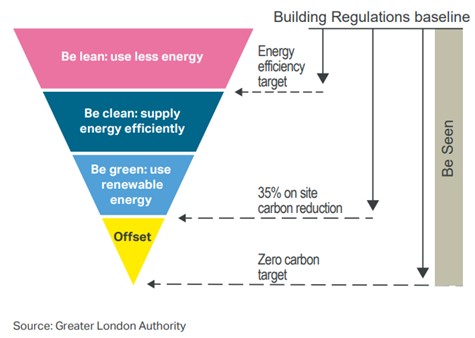
Where the London Plan zero carbon target cannot be met through on-site measures, it should be achieved via carbon offset payments. However, there must be a minimum on-site reduction of at least 35% beyond Building Regulations
Whole Life Cycle Carbon and Circular Economy Reporting
Additionally, where a development is referable to the mayor, a Whole Life-Cycle Carbon (WLC) Assessment and a Circular Economy review should also be undertaken to fully capture the building’s carbon impact.
WLC emissions are the emissions associated with the construction and the operation of a development over its life cycle (with the study period set at 60 years). WLC assessments should be submitted at pre-application (where relevant), with the planning application, and post-construction (but prior to occupation of the development). Results must be reported using a tool developed by the GLA, against benchmarks also developed by the GLA. While the WLC Assessment is not subject to the net zero carbon targets, it encourages strategic decisions to reduce WLC emissions to meet the benchmarks.
Policy SI7 focuses on waste reduction and the circular economy. Referable applications must submit a Circular Economy (CE) Statement, which should demonstrate:
The CE Statement should cover the whole life cycle of the development. This policy is intended to encourage material retention, reuse and recycling, leaving minimal waste behind. A CE approach can be adopted more easily using a ‘building in layers’ framework. Different layers should be independent, accessible and removable, where this is feasible.
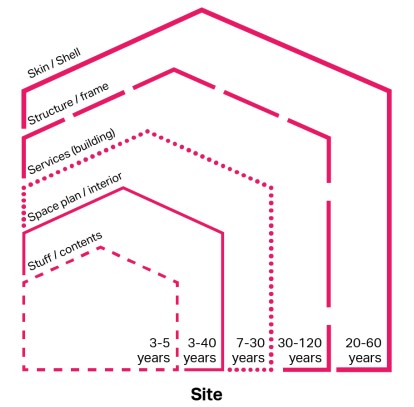
Source: GLA Circular Economy Statements
Going beyond London
While these requirements have only officially come into effect in the Greater London area, we have seen other local authorities adopting similar methodologies in some cases. The stricter and more robust requirements symbolise an overall change within the industry, one which we believe to be positive, driving more innovative solutions for sustainable design. We expect to see more planning policies incorporating these changes around the rest of the UK over the coming years.
Ridge can offer a full suite of sustainability, energy and net zero carbon services to support clients in complying with these requirements. This includes:
For more information, please contact:
Xenia Kaldy
Senior Sustainability Consultant (Winchester)
xeniakaldy@ridge.co.uk

Thank you for signing up. We look forward to sharing updates with you